A documentary, 'The Godmother - Italy', by Journeyman Pictures from February 2001 reveals the women of the mafia. As the mafia godfathers are being jailed and killed by rivals, it is the godmothers, like Maria Licciardi, who are taking over.
Showing posts with label Famous Italians. Show all posts
Showing posts with label Famous Italians. Show all posts
Monday, October 22, 2012
Friday, September 14, 2012
Giuseppe Impastato

A young Giuseppe with his father Luigi Impastato and mother Felicia Bartolotta
Giuseppe Impastato, also known as Peppino, was born on the 5th of January 1948 in Cinisi, Palermo, Italy. Impastato was famous for his opposition to the Mafia, and his political activism led to his murder on the 9th of May 1978.
Impastato was born into a Mafia family. His father Luigi had been sent into internal exile during the reign of Fascism, and was close friends with Gaetano Badalamenti, a Mafia boss. His uncle, Cesare Manzella, a high-profile Mafia boss, was killed in a car bomb attack in 1963. Later, Giuseppe's brother Giovanni, made comment that this tragedy struck a chord with the fifteen-year-old Peppino. Pieces of Manzella were found hung on lemon trees hundreds of meters from the crater where the car had been. Giuseppe remembers his brother as having said, 'Ma questa è veramente mafia? Se questa è mafia io per tutta la vita mi batterò contro queste cose.' (Is this really Mafia? If this is Mafia I will fight it for the rest of my life.' As a youth, Giuseppe disassociated himself from his father, was kicked out of his home, and began his anti-Mafia activism.

In 1965, Peppino began the newsletter named L'idea socialista, and joined the left-wing PSIUP party (Italian Socialist Party of Proletarian Unity). From 1968 he played a major part in the revolutionary activities that were emerging; fighting for the rights of peasants, building workers, and the unemployed. In 1975, with other youths of Cinisi, Music and Culture was set up; a group which organised debates, film, theatre, and music shows, as well as beginning a self-funded radio station Radio Aut. Peppino's weapon against the mafia was his use of satire; which he used abundantly to mock both politicians and mafiosi on his daily radio programme Onda pazza (Crazy Wave). 'Its highlight was an evening show of music and satire directed at 'Mafiopolis' and its 'Mafia-cipality' - in other words Cinisi and its DC-dominated town council. The show's sketches lampooned the local Family and its shady affairs by setting them in grotesque versions of Dante's Divine Comedy or the Wild West; ruling boss Tano Badalamenti was transparently mocked as 'Tano Seduto' (Sitting Bully). Through the medium of the radio he would announce stories of crime, heavily implicating and implying the involvement of the local mafia. Although the radio show was popular with people, Impastato and his friends who were disliked by the authorities; revealing perhaps, just how deeply the influence of the mafia ran.
Impastato recognised the danger that mafia leader Tano Badalamenti posed, and vice versa. Badalamenti did not like Impastato's public activism. It is believed that Peppino's father tried to protect his son, but after his own death by a car in September 1977, a suspected but never proven murder, Badalamenti gave the order for Peppino's murder.
Peppino Impastato was killed on the night of his election campaign, as he was running for the Cinisi council elections for the Proletarian Democracy.
'On the night of 8-9 May 1978, Peppino was kidnapped on his way back from Radio Aut and taken in his own car to a tumbledown stone shack a few yards from the Palermo-Trapani railway line near the boundary fence of the airport. There he was beaten and tortured before being dumped on the track with several sticks of dynamite strapped to his torso.
Early the following morning railway workers reported that a fifty-centimetre section of track had been damaged. When the caravinieri arrived at the scene, they found Peppino's car, his white Scholl clogs and his glasses near the hole blown by the explosion. Fragments of his body and clothes were scattered over a 300 metre radius around it; only his legs, parts of his face, and a few fingers were recognisable. Peppino's death was a horrific echo of the way his uncle the mafiosi had died back in 1963 - the very murder that had provoked him to ask, 'What must he have felt?' and begin his rebellion against the mafia.'

At first, the press, police, and the investigation authorities believed Giuseppe Impastato had been a terrorist who had attempted to bomb the railway, but had accidentally killed himself. A letter that he had written months before his death was found, and there was now speculations of suicide. But it was his brother Giovanni and his mother Felicia Bartolotta, who separated themselves from their mafia family, together with Giuseppe's activist friends, and the Centro siciliano di documentazione, that fought for the recognition of the mafia as being responsible for the murder.
Salavatore Palazzolo spoke out against the Cinisi Mafia, of which he had once been a member, and named Badalamenti as the one who had ordered the killing of Impastato. In June 1996, the case was reopened, and in Novemeber 1997, a warrant was issued for the arrest of Badalamenti. It wasn't until 2002 that he was given a life sentence. Felicia Bartolotta made a dignified statement after the verdict was announced, 'I never had any feelings of vendetta. All I have done is call for justice for my son's death. I have to confess that, after so many years of waiting, I had lost faith - I never thought we would reach this point. Now I feel a great deal of contentment, of satisfaction. I always knew what happened. Badalamenti used to call my husband Luigi to complain about Peppino, and my husband begged him not to kill the boy.'
Quotations taken from 'Cosa Nostra: A History of the Sicilian Mafia' by John Dickie
Salavatore Palazzolo spoke out against the Cinisi Mafia, of which he had once been a member, and named Badalamenti as the one who had ordered the killing of Impastato. In June 1996, the case was reopened, and in Novemeber 1997, a warrant was issued for the arrest of Badalamenti. It wasn't until 2002 that he was given a life sentence. Felicia Bartolotta made a dignified statement after the verdict was announced, 'I never had any feelings of vendetta. All I have done is call for justice for my son's death. I have to confess that, after so many years of waiting, I had lost faith - I never thought we would reach this point. Now I feel a great deal of contentment, of satisfaction. I always knew what happened. Badalamenti used to call my husband Luigi to complain about Peppino, and my husband begged him not to kill the boy.'
Quotations taken from 'Cosa Nostra: A History of the Sicilian Mafia' by John Dickie

Friday, August 31, 2012
Maria Montessori


Today, Google presents a doodle commemorating the 142nd birthday of Maria Montessori (31 August 1870 - 6 May 1952), an Italian physician and humanitarian, but perhaps best known as an educator. Born in Chiaravalle, near Ancone, Marche, she had initially wished to become an engineer, but later changed her mind and studied medicine and psychiatry, a massive accomplishment for a woman at that time. In 1896 she became Italy's first female doctor when she graduated from Università La Sapienza di Roma.
Montessori was highly influential in her educational methodology of measuring and observing students, often those who were disabled, and encouraging a kinetic way of learning as a method of remembering. She believed that learning was to be based on activities of a child's choice, and that it was important that they were given the freedom to develop in whichever way they wanted, so that they enjoyed what they were doing. Montessori had worked in the psychiatric hospital of Santa Maria della Pietà, and was shocked that children were treated in the same manner as adults. She believed that as children all have different stages of development, and that educators must adapt their teaching style to each individual student's abilities and capabilities. Montessori regarded 'spontaneous discipline' in the children as vital to their learning.
The Italian Minister of Education in 1896 was impressed with a lecture given by Maria Montessori at the Educational Congress, in which she had spoken about educating the disabled. He offered her the position of director of the Scuola Ortofrenica, an institution which looked after and educated the mentally disabled. Her methods of teaching were so revolutionary and effective that when some of the children sat national school exams, they passed with above average results. Montessori was pleased with this and developing from the knowledge she had from teaching the disabled children, she opened Casa dei Bambini in 1907 for 'normal' children in San Lorenzo, one of the poorest neighbourhoods of Roma. It was the first Montessori school, and quickly gained success with her techniques of teaching, soon there were more, even spreading throughout the world.
However, with the rise of Fascism, Montessori had no place. Initially Mussolini supported her, but she and the new government soon came into conflict over her methods of education and her position on peace. In Mussolini's opinion, the Montessori system did not train good soldiers, and she spent years under political surveillance. She fled to Spain, and then with the Spanish Civil War, left to Holland. Maria Montessori's influence on the approach to education can be felt all over the world, her recognition of the importance of freedom and self-directed learning within a controlled and well-equipped environment has affected the teaching strategies of many teachers and educators.

The 1000 Lira note depicted Maria Montessori
Sunday, August 26, 2012
Fido

La Domenica del Corriere
22 June 1958
La morte del cane Fido: E' morto Fido. Il cane, al quale era stata assegnata una medaglia d'oro ed eretto un monumento, è morto. La sua storia è quanto mai commovente. Nel 1943 perse il padrone, vittima di un bombardamento aereo. Per quattordici anni, tutte le sere, la brava bestiola si recò ad attendere la corriera che solitamente riportava il suo amico a Luco di Mugello e si fermava finchè non c'era più speranza di vederlo. Da qualche tempo, stanco e deperito, aveva sospeso le visite. L'altro giorno, presentendo la fine, volle recarsi all'ultimo appuntamento. Due ragazzi trovarono il suo corpo inerte sulla strada.
The death of the dog Fido: And Fido is dead. The dog, who had been awarded a gold medal and a monument, has died. His story is very touching. In 1943 he lost his master, the victim of an air raid. For fourteen years, every night, the good animal went to wait for the bus that usually brought his friend into Luco di Mugello and stopped until there was no more hope of seeing him. For some time, tired and emaciated, he had suspended visits. The other day, sensing the end, he wanted to go to the last appointment. Two boys found his lifeless body on the road.
Many dogs are named Fido, but the most famous of all was an Italian streetdog who was born in the Autumn of 1941 in Borgo San Lorenzo, Tuscany, Italy.
A street dog without a home, Fido was found by Carlo Soriani, injured and lying in a ditch. Soriani was a brick-kiln worker returning home, and not knowing where the dog came from, he brought the dog home and with his wife, they nursed the dog back to health. They adopted him and gave him the name 'Fido', a Latin name meaning 'faithful'. Extremely loyal to his master, Fido would follow Soriani to the bus stop as he left for work, and would wait patiently in the piazza until the bus would bring him back, and the pair would walk home together. This continued for two years, but on the 30th of December 1943, during World War II, Borgo San Lorenzo was attacked by allies, and many factories, including the one in which Soriani worked, were hit. Soriani tragically lost his life on this day. Fido, however, did not know what had happened to his master and went back to the bus stop that night, waiting for his return. Eventually he went back home, but for the next fourteen years, the ever faithful companion would go to the bus stop at the piazza, waiting for Soriani to come back. Many were enamoured and touched by his faithfulness, and his story was told by Italian magazines and on the newsreels. On the 9th of November 1957, the mayor of Borgo San Lorenzo awarded Fido a gold medal in front of Soriani's widow and many townspeople. The sculptor Salvatore Cipolla was commissioned by the town to sculpt the dog in honour of his love and faithfulness. The finished work was displayed in Piazza Dante. However, mere months after its placement, vandals destroyed the majolica statue, and Cipolla was commissioned to recreate his original work in bronze, still seen in Piazza Dante.
On the 9th of June 1958 Fido passed away, still waiting in vain for his friend to return from work. He was buried beside his master. Both La Domenica del Corriere and La Nazione dedicated their front pages to Fido and his heart-warming story of devotion.


Wednesday, August 22, 2012
The Melis Family

The Melis family are brothers and sisters who together hold the Guiness World Record for being the world's oldest siblings, with a combined age of 818. The names of the siblings in order of age are, Consolata, Claudina, Maria, Antonio, Concetta, Adolfo, Vitalio, Fida, Mafalda.
Here is an article about the family from The Telegraph:
Sardinian siblings aged 818 officially the world's oldest
by Nick Squires, Rome. 21 August 2012
'Experts attribute the ripe old age of the Melis family to a combination of good genetics, a healthy diet and an active lifestyle.
They come from the village of Perdasdefogu in a mountainous region of Sardinia called the Barbagia, which was known to the ancient Romans as ‘Barbaria’, or land of the barbarians.
The ruggedness of the region has repelled invaders for centuries, helping to maintain a distinct gene pool.
The oldest of the siblings, Consolata, will celebrate her 105th birthday today/on Wednesday, while the “baby” of the family, Mafalda, is a comparatively spry 78 years old.
The siblings say part of the secret of their longevity is being surrounded by their 150 children, grand children and great-grand children.
Consolata alone has nine children, 24 grand children, 25 great-grand children and three great-great grandchildren, with a fourth on the way. Born on Aug 22, 1907, she has lived through nine papacies.
Remaining active also appears to be key to the siblings’ longevity – another sister, Claudina, 99, goes to church every day, while a brother, Adolfo, 89, still works in a bar in the village and spends his spare time growing vegetables in his garden.
“In my day women had to do all the domestic work, going to the standpipe to get water and to the river to wash the clothes. My grandchildren have washing machines and vacuum cleaners so when they say “I’m so stressed”, I just can’t understand it,” Consolata told Corriere della Sera newspaper.
Two of the brothers fought the Germans during the war – 93-year-old Antonio helped repel a German advance at Viterbo, north of Rome, while Adolfo once hid in a well to escape a Nazi assault.
The large size of the family was recognised in 1940 by the Fascist regime of Benito Mussolini, who awarded their mother, Eleonora, a Medal of Honour and a certificate.
“The Mediterranean lifestyle is always held up as being beneficial to a long, healthy life, and Italians in particular feature prominently in the list of super-centenarians and centenarians,” said Craig Glenday, editor-in-chief for Guinness World Records.
Of the 70 people in the world who are over the age of 110, seven are Italian and the world's second-oldest person is an Italian-born woman who now lives in the US, he said.
“Genes and lifestyle are paramount, but luck plays a big part – avoiding accidents and falls, and so on – so to have such a large number of living siblings with an average age of more than 90 years is incredibly rare.”
Amarilis Whitty, also from Guinness World Records, said the claim was put forward by a friend of the family. “It was only recently verified. They were able to provide all the information we had, from birth certificates to other family records,” she told The Daily Telegraph.
The secret of Sardinians’ long life is being studied by a scientific project called AKeA – an acronym for “A kent’ annos”, a traditional toast in the Sardinian language which means “may you live to 100 years.”
Diet is considered crucial – Sardinians eat less carbohydrate-heavy pasta than their counterparts on the mainland of Italy and their diet is particularly rich in proteins derived from milk and cheese.
Islanders traditionally eat sugary foods sparingly, with desserts and pastries reserved for saints’ days and festivals.
But scientists believe genetics also play a key role. Resistant to foreign invaders since Roman times, the Barbagia region has a comparatively small gene pool in which beneficial traits such as longevity are passed on from generation to generation.
“On the one hand it is about genetics, about inherited longevity – as shown by the fact that the surnames of centenarians crop up again and again,” said Luca Deiana, a professor of clinical biochemistry from the University of Sassari in Sardinia.
“But there is also the bounty of the land and the fruit it produces, particularly pears and prunes,” said Prof Deiana, who has studied 2,500 centenarians on the island since 1996.
The fact that Sardinians continue to hold their elderly people in high regard and include them in family life was also a factor, he said.'
Monday, August 13, 2012
Mamma Coraggio

Angela Casella is known to most of Italy as Mamma Coraggio, 'Mother Courage'. On the evening of the 18th of January 1988, her 18-year-old son, Cesare Casella, was kidnapped by the 'ndrangheta, the Calabrese Mafia from Southern Italy, who, in the 1970's and 80's, had formed a 'professional' kidnapping industry that came to be known as Anonima Sequestri (Kidnapping Anonymous). Cesare was abducted from his hometown, Pavia, in Northern Italy, just outside his father's Citroen dealership. Cesare was hidden in a garage near Pavia for ten days, before being transferred to Aspromonte, moving to three different locations during his captivity. In a book he published after his release, he described his prisons as being 'holes', dug in the ground; 2m long, 1m wide, and 1.5m high. At the foot of a tree, he was chained by the ankle and by the neck. The walls were lined with stones and a sheet of metal, covered in leaves, was the roof.
Cesare's kidnappers initially demanded eight billion Lira as ransom. After much negotiation, the sum was reduced to one billion Lira; which the Casella family paid in August 1988, but Cesare was not released. After more time, the kidnappers asked for another five billion Lira, which the family just could not afford. Cesare's father Luigi was a car dealer, and his mother Angela was a secretary for the family business. The Italian State would not allow the Casellas to raise the money, freezing their bank account and assets, as they feared paying the ransom would only encourage further abductions for money.


In June 1989, Angela Casella had had more than enough, extremely worried in the seventeen months since her son had been kidnapped, and with only infrequent contact with the kidnappers, she made up her mind to go down to Calabria herself to plead for and win the solidarity of the Calabrese women. She went through the towns and villages of Aspromonte, Calabria; chaining herself in the piazze and sleeping in a tent, trying to communicate to the locals the horrific conditions her son was being kept in. The media publicised her plight and Angela was dubbed Mamma Coraggio, for her braveness and courage to stand up to those who had taken her son.

Finally, in December of 1989, the police caught and arrested one of the kidnappers as he went to collect half a billion Lira in ransom money. The other kidnappers now felt threatened by the police and with all the publicity, could not hide the boy any longer. On the 30th of January 1990, after a terrifying 743 days in captivity, Cesare Casella was released. The man they caught during the ransom collection would be the only kidnapper the police would ever find. Cesare would go on to write a book about his ordeal and Mamma Coraggio had a brief stint in politics before the family settled down to a quiet, normal life.

Angela Casella passed away in December 2011. What an amazing mother. What an amazing woman.
Tuesday, July 31, 2012
Alex Giorgetti

So, with all this hype of the Olympics, I thought I had better post something related to it. Rather than news of the actual games; sports are something I know extremely little about; here is a post about an Italian Olympic athlete instead. Alex Giorgetti is a water polo player for the Italian men's team, which is nicknamed Settebello. The Italian water polo team is one of the best in the world, over the years it has accumulated six Olympic medals in the sport, also winning 5 World Championships, 5 World Cups, 10 European Championships medals, and one World League medal.
Alex Giorgetti was born on the 24th of December 1987, in Budapest, Hungary and with dual-citizenship, has also lived part of his life in Savona, Italy. He stands at a height of 187cm and has the current weight of 78kg. He plays for Pro Recco and in 2011, Giorgetti won World's Best Water Polo Player. Also, he plays as number five, my favourite number and the number of Fabio Cannavaro in Forza Azzurri.
I can't seem to find any videos on youtube that I can actually understand; there are more uploaded interviews in Hungarian than in Italian. I should get my Hungarian friend to translate them for me haha. But here are a few anyway:
I did, however, find an interesting interview with Giorgetti about his conversion to Catholicism and a visit to the pilgrimage site of Medjugorje, in Bosnia and Herzegovina, where apparently, people have seen apparitions of the Virgin Mary. The entire phenomenon is not endorsed by the Catholic Church and it has come under much scrutiny and criticism; though that hasn't stopped the estimated 30 million who have visited the site since 1981, when the apparitions were first reported. The whole thing kind of seems like a psychological scam, but what Giorgetti said about his faith is quite fascinating. (I have had to edit the English translation because it didn't make sense, but have only made minor grammatical corrections.)
 'Poiché l'Italia non vinceva il campionato del mondo da ben vent’anni, ho preso la decisione che se avessimo raggiunto un buon risultato sarei venuto a Medjugorje a ringraziare Gesù per questo. Non solo siamo diventati campioni del mondo, ma sono anche stato premiato come miglior giocatore del campionato. Ecco perché ho deciso di venire a ringraziare Gesù e Nostra Signora per tutte le grazie che mi ha concesso. Ho salito la collina dell’Apparizione e la montagna della Croce a piedi nudi ed è stata un esperienza davvero bella per me. Mi sento contento e soddisfatto e non vedo l’ora di tornare in Italia a testimoniare la bellezza di questo luogo. Sono arrivato qui con mio fratello gemello. Prima, non ci parlavamo; ne mai gli ho detto che gli volevo bene. Non è mai andato in chiesa, non ha mai pregato e ora per la prima volta qui è andato a confessarsi ed alla santa messa. Vedo tutto ciò come frutto della mia conversione e sono davvero felice di vederlo così allegro, non era mai successo in passato. Non era stato fortunato come me nella vita, perché era nato con un handycap fisico e tutto ciò lo ha influenzato. I nostri genitori ci hanno sempre separati in tutto quello che dovevamo fare. Mia madre ha dimostrato più affetto a me ed io ero quello con i vestiti migliori, i giocattoli, quello che ha ricevuto più caramelle e dolci durante il periodo della nostra infanzia. Lei vedeva che amavo gli sport e che ero portato per la pallanuoto e per l’allenamento in piscina. Ho avuto una vita perfetta; Ero giovane, di bell’aspetto e di successo, mentre mio fratello era solo e triste. Ero troppo egoista per vederlo. Non ho avuto necessità di comunicare molto con la mia famiglia perché ho avuto tutto dalla vita: soldi, ragazze e carriera. Ma tutto questo non è durato troppo a lungo. Ho concluso il lungo rapporto che avevo con la mia ragazza. La amavo davvero, ma era interessata soltanto a soldi ed alla gloria. Ho rifiutato l'invito del Coach nella nostra nazionale ed ero completamente disperato, distrutto, senza famiglia, amici, senza ragazza e carriera.
Ero sull'orlo della depressione. Poco dopo conobbi una coppia di fratelli gemelli che hanno condiviso con me la storia della loro conversione. La loro storia mi ha toccato profondamente ed ho deciso di raccontare loro i miei problemi, la mia solitudine ed il mio disagio. Ho desiderato l’aiuto di Gesù, per cambiare vita e darmi la pace che desideravo così profondamente. Da quel momento sono cominciati i cambiamenti nella mia vita. Mi sono confessato, ho iniziato ad andare alla santa messa, a leggere la Sacra Bibbia e ad aiutare i poveri. La mia vita è cambiata completamente. I rapporti con la mia famiglia e con la gente sono cambiati, pieni di significato, la mia carriera è avanzata e sono diventato una persona nuova. Era semplicemente Dio che volgeva tutto al bene.
La mia famiglia ed i miei amici hanno letto della mia conversione sui giornali, e quando ho deciso di condividere tutto con la gente sono rimasti molto sorpresi. La cosa più bella è quando potete vivere nella verità ed essere chi realmente siete. La mia nuova vita è appena cominciata ed il mio desiderio è di incontrare Gesù ogni giorno di più. Spero che la mia storia sia di esempio per altri giovani affinché cambino vita e capiscano che senza Gesù le loro vite sono senza senso.' (Alex Giorgetti)
'Since Italy has not won the World Championship in the last twenty years, I made the decision that if we achieved a good result, I would come to Medjugorje and thank Jesus for that. Not only did we become the World Championship Winners, but I was awarded as the best player of the Championship. That is why I decided to come and thank Jesus and Our Lady for all of the graces they bestowed upon me. I climbed Apparition Hill and Cross Mountain in my bare feet, and that was such a beautiful experience for me. I feel content and fulfilled and cannot wait to return to Italy so I can be a witness about the beauty of this place. I arrived here with my twin brother. Before, we never spoke together; I never told him that I loved him. He never went to church, never prayed and now for the first time he went to confession and Holy Mass here. I see all of that as fruits of my conversion and I am so happy to see him as joyful as he is, that was never the case in the past. He was not as lucky as I was in my life, because he was born with a physical disability and all of that influenced him. Our parents always separated us in everything we were to do. Mother showed more affection to me and I was the one with better clothes, toys, the one who received more candies and sweets throughout the time of our childhood. She could see that I loved sports and that I was talented for water polo and she was always taking me for training practice at swimming pools. I had the perfect life; I was young, good-looking, and successful while my brother was lonely and sad. I was even too selfish to see that. I did not have a need to talk to my family because I had everything else in my life: money, girlfriends and a successful career. But all of that did not last too long. I ended the long relationship that I had with my girlfriend. I loved her sincerely, but she was interested only in money and glory. I rejected an invitation from our National Team Coach and I was completely desperate, broke, without family, friends, without a girlfriend and a career.
I was nearly in depression. Shortly afterwards, I got to meet a pair of twin brothers who shared their story of conversion with me. Their story touched me deeply and I decided to share with them my own problems, my loneliness and my restlessness. I wanted Jesus to heal me, to change my life and give me peace that I was longing for so deeply. That is when changes started to take place in my life. I confessed, started going to Holy Mass, reading the Holy Bible, and helping the poor. My life was changed completely. Relationships with my family and other people became different, full of meaning; my career was advancing again and I became a new person. It was simply because God turns everything to good.
My family and my friends read about my conversion in newspapers, after that I decided to share with other people and they were truly surprised. The most beautiful thing is when you are able to live the truth and to be what you really are. My new life has just begun and my desire is to meet Jesus more and more with each day. I hope my story will be an example to other young people to change their lives and to understand that nothing in their lives makes sense without Jesus.' (Alex Giorgetti)
Thursday, July 26, 2012
Rita Atria
On the 26th of July 1992, a young seventeen year old Italian girl committed suicide. This is Rita Atria's story.
Where talking is met with deadly silence: In a small town on a Sicilian hilltop, a young woman could no longer keep quiet after the Mafia shot dead first her father, then her brother. Clare Longrigg reports on the courage, the fear and the tragic death of Rita Atria.
by Clare Longrigg, The Independent, Monday 21 September 1992.
 NICOLO ATRIA and Piera Aiello were married in Partanna, a little hilltop town in the beautiful and fertile Val del Bellice, in western Sicily. When their baby was three, they moved to Montevago, a village near Agrigento, and set up their own pizzeria.
On the day of the opening, in June last year, they held a modest celebration, and invited a few neighbours. The guests departed early. As Nicolo was clearing away, a man walked into the restaurant and shot him. Nicolo died in Piera's arms. He was 24.
It was a settling of scores between Mafia clans, and people knew better than to interfere. Nicolo's father, Vito, a shepherd, had been shot dead in 1985 by a hitman from a rival family. Nicolo was 18 at the time, the only son, and he talked obsessively about avenging his father. He probably knew who the murderer was; perhaps, in his eagerness to be taken seriously, he had talked too much about his vendetta.
The police made half-hearted inquiries into Nicolo's death, but were greeted by silence. This is Mafia heartland, and nobody talks to the police, not even to ask the time of day. That would have been the end of it, had it not been for Nicolo's sister. Rita was 18, a quiet girl, ordinary-looking, short, with dark brown hair and black eyes. Her father and now her brother had been murdered, and she knew that the killers were free and had nothing to fear: Mafia hitmen are seldom arrested and almost never tried for murder.
Rita had been timid and unassuming, always in the background of small-town life. Unable to suppress her grief and anger any longer, she took her revenge. She disobeyed the Mafia's most powerful, unwritten law - instilled into her from her earliest childhood. A month after her brother's murder, she went to the police with his widow, and talked.
The police took the women straight to Paolo Borsellino, the magistrate conducting investigations into Mafia activity in the west of Sicily. Rita's anger came out in a torrent of words. She told Borsellino about the war between the Mafia families of Partanna, in which 30 people have died in the past few years; she named the heads of the most powerful families. She named the men who had killed her father and her brother. Borsellino questioned her about Partanna's most notorious unsolved murder: the shooting of the deputy mayor in 1983. Rita told him what every other resident of Partanna believed, but would not say: that the former mayor had killed his own deputy.
Last October the police made their move. Ten people were imprisoned for Mafia crimes on the evidence of Rita Atria's testimony, and in the following months, 20 more mafiosi were behind bars. When her mother found out that Rita was collaborating with the police, she threw her out. It did not matter that her own son's killer was to be brought to justice; as far as she was concerned, the police were on the wrong side of the law. Borsellino was afraid the Mafia would discover the identity of his source and try to silence her. Rita was taken to a seventh-floor flat on the outskirts of Rome, where the only people she knew were her police guards. Borsellino became her lifeline.
On Sunday 19 July, Paolo Borsellino was blown up on the doorstep of his mother's house in Palermo. Italy reeled with the shock. Rita, alone in the apartment in Rome, read the papers and saw the mangled cars and bodies on television. A week later, she locked herself into the apartment and wrote a note, which said: 'I am devastated by the killing of Judge Borsellino. Now there's no one to protect me, I'm scared and I can't take any more.' Then she threw herself out of the window.
It took two days for the newspapers to trace this anonymous suicide - no one in the apartment block knew the girl on the seventh floor, and no one but Borsellino and his colleagues had seen her for months. Anti-Mafia campaigners instantly adopted Rita as a martyr. The unknown heroine was splashed across every front page, but no one had a picture of her.
The road to Partanna winds through the rich countryside, past fields of melons and corn. As you approach the small hilltop town, the road rises in a grandiose arc and curls into a massive spaghetti junction. But this astonishing construction does not actually lead into the town. You have to circle the summit and go down again, turn down a side street and enter the town on the old, broken road.
Partanna was partially destroyed by earthquakes in 1968, and, after almost 10 years, the money began to arrive to rebuild it. Rivers of money, from the EC and the state, went straight into the pockets of the Mafia. Individuals were paid to rebuild their own palatial villas. The approach road with no exit appeared, while the church roof still lies where it fell.
On the day of Rita Atria's funeral, journalists and anti-Mafia campaigners arrived from Palermo and wandered about in the blistering heat, trying to find out when the ceremony would take place. There was a confusion about the proceedings that heightened the mutual suspicion between the townsfolk of Partanna and the unwelcome visitors. At the town hall, they said Mass would be held at noon. At the church, a man said there would be no funeral for Rita.
At one o'clock, Don Calogero Russo, the parish priest, stepped out to the vestry in the middle of another funeral, and was taken aback to find a group of women waiting for him, demanding to know what was happening and when the funeral would be. 'These are terrible times. It's a cruel world. What a dreadful thing to happen,' he said in an unctuous voice. 'We won't be saying Mass for the poor girl, her family doesn't want us to.'
This was difficult to believe: there had been no sign of a single member of Rita's family since the news of her death had broken, and her sister-in-law, who had gone to the police with her, was still in hiding. The women were indignant. As they walked away, one remarked that a priest who would not say Mass for a girl who had betrayed the Cosa Nostra must be a mafioso. Another said that because Rita had committed suicide, the priest would not bury her in holy ground.
The citizens of Partanna seemed rather inclined to forget who Rita Atria was. But a bar owner was more helpful. She said that Rita's mother was in the local hospice for the poor, being looked after by the nuns. 'She's only 50, but they say she's gone mad. I'm not surprised after what has happened.'
The hospice is surrounded by 20ft walls, with a solid steel gate and electronic surveillance. A voice on the entryphone beneath the eye of a video camera shrieked at the outsiders to go away.
At five o'clock the entrance to the cemetery was blocked by television cameras and press photographers. Journalists and anti-Mafia campaigners outnumbered the local mourners, and searched frantically for anyone who had known the dead girl. A strangled howl among the tombs sent the press corps half-running towards Rita's family grave. The mother? But the old woman in black, grey hair wild about her crumpled face, was not related. A group of women from Partanna looked on uneasily. They all said they didn't know Rita Atria, but it was a pity, such a young girl . . .
To a brief burst of applause, Rita's coffin came unsteadily down the path. It was carried by a dozen women from Palermo, heroines of the anti-Mafia movement who jostled for position to pay homage to their dead sister. At the rear was Michela Buscemi, who had taken her brothers' mafioso killers to court; leading the mourners was Letizia Battaglia, who spent two years photographing the shattered corpses of Mafia victims, in protest against Cosa Nostra.
The coffin was followed by the mayor and three carabinieri in uniform, bearing a standard - it had been decided, at short notice, that Rita was an official heroine. Father Russo celebrated Mass under a piercing blue sky, the cyprus trees rustled by a gentle breeze. The small crowd filtered through the graves, standing on the tombs to get a better view. The mayor gave a long speech about Rita's bravery, without once mentioning the Mafia.
Father Russo recited: 'Pardon your servant for her sins. . . .' 'Rita non ha peccato, ha parlato,' cried out one of the protesters. 'Rita did not sin, she talked. And what she said was the truth.' There was a shocked silence, then a ripple of cautious applause.
Rita was not the first to talk. In recent years, a number of women from Mafia families have denounced the killers of their husbands or sons. All of them have been ostracised by their families as a result, many have had their livelihoods destroyed. When Michela Buscemi testified against the killers of her brothers, Salvo and Rodolfo, her bar in Palermo was blown up and her mother disowned her; it was not until her four-year-old daughter's life was threatened that she withdrew her case. Pietra Lo Verso's husband fell foul of a Mafia boss and was shot dead in a massacre that killed eight people. She took his killers to court; as a result, customers deserted her shop, her parents cut her out of their lives, and her sons will not allow her to speak to anyone.
During his last investigations, Judge Borsellino maintained that the only effective weapons in the war against the Mafia were the pentiti - the 'penitent' mafiosi who, out of fear or revenge, revealed the inside workings of the impenetrable organisation - and the innocent members of Mafia families who knew the names of killers and bosses. He knew what would happen to a woman who betrayed her family to the police, and he used to give his 'penitents' personal support, remembering birthdays and Christmas presents for the children. Just before he died, he had requested better protection for these informers.
When Rita Atria's funeral was over, the journalists, giving up hope of finding anyone who had known her, interviewed each other outside the cemetery gate. But as the people of Partanna edged back up the hill to their homes, one woman spoke up. 'I didn't know Rita, but I came to her funeral because I believe in what she did,' she said rapidly as the reporters closed in around her, wielding microphones. 'We are all to blame for her death, because of our silence. But what happened to her is not going to change anything around here. It's not going to make anyone else talk.'
Source: The Independent
Thursday, July 19, 2012
Paolo Borsellino

Corriere della Sera 20 July 1992
Today is the anniversary of Paolo Borsellino's assassination on the 19th of July 1992. I wasn't old enough to remember this day, but my mum says she can still remember watching the horrific events on the news all those years ago. Less than two months after the murder of his fellow prosecutor friend, Giovanni Falcone, Borsellino was targeted by the mafia and brutally killed. Both men died by car bombs; Falcone with his wife and three bodyguards, Borsellino with five policemen.
Here is the blog I wrote earlier on for the anniversary of Giovanni Falcone's death, with information about both Paolo Borsellino and Rita Atria also. Amazing people whose lives were cut short much too prematurely. http://allthedaysordained.blogspot.co.nz/2012/05/giovanni-falcone-paolo-borsellino-and.html
'Chi ha paura muore ogni giorno, chi non ha paura muore una volta sola.'
'Those who are scared die everyday, those who are not scared die only once.'
- Paolo Borsellino


Massacre of Capaci (Giovanni Falcone)
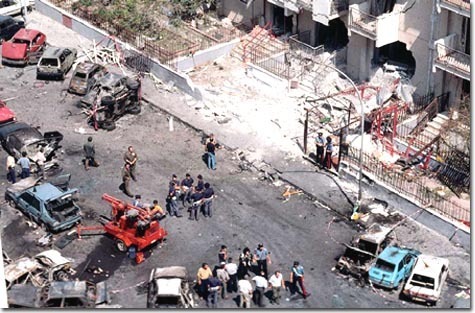

Massacre of Via D'Amelio (Paolo Borsellini)
Wednesday, May 23, 2012
Giovanni Falcone, Paolo Borsellino, and Rita Atria

This year is the 20th anniversary of the deaths of Giovanni Falcone and Paolo Borsellino, two brave men who fought against the mafia, convicting more than 300 criminals. The two Palermo prosecutors were childhood friends who grew up to risk their lives bringing the members of the notorious Cosa Nostra to justice. This photograph was taken just months before their murders, in a moment of calm framed by the immense pressure of their situation. This image is now in almost every Italian judicial office, and in many schools and city halls throughout Sicily; reflecting just how influential and inspirational they were.
On the 23rd of May 1992, Giovanni Falcone, together with his wife Francesco Morvillo and three of their bodyguards, were tragically killed on highway 29, between Palermo and the airport. The mafia had planted the bomb to end the life of the man who had jailed so many in the maxi-trials. Falcone had been one of the first to follow the 'money trail' of the mobsters and was a major part of the exposure of massive heroin trade that was disguised by the front of pizza parlours.
Just months after the assassination of his friend Falcone, on the 19th of July, Borsellino and five policemen were killed by a car bomb in Via D'Amelio, near his mother's home. Borsellino left behind his wife, Angela Piraino Letto, one son, and two daughters.
A week after Borsellino's death, on the 26th of July, Rita Atria committed suicide. Atria was a young woman born into a Mafia family who had broken the code of omertà, working closely with Borsellino as she named the men of the rival Mafia who had killed her father and brother. Although she was aiming to bring their murderers to justice, Atria's own mother disowned her; for to her, like to many Mafia families, the police are always the enemy. With her brother's widow, Piera Aiello, and the help of Borsellino, Atria testified against the Mafiosi; and in doing so, endangered her own life, leading to her relocation to a hidden position in Rome. Abandoned by her family, Borsellino had been her father figure, supporting her in her ordeal. But when he was killed, Atria felt overwhelmingly terrified and unprotected; throwing herself out of her apartment window. She was only seventeen.
Salvatore Riina, the godfather of the Corleonesi Mafia was sentenced for life imprisonment for sanctioning the murders of Falcone and Borsellino, alongside numerous other crimes.
'È normale che esista la paura, in ogni uomo, l'importante è che sia accompagnata dal coraggio. Non bisogna lasciarsi sopraffare dalla paura, altrimenti diventa un ostacolo che impedisce di andare avanti.'
'It is normal that there is fear, in every man, the important thing is that it is accompanied by courage. We must not be overwhelmed by fear, otherwise it becomes an obstacle to moving forward.'
- Paolo Borsellino
Wednesday, March 7, 2012
Alessandro Manzoni

Google Italia's cover illustration is dedicated to Italian writer Alessandro Manzoni, on his 277th birthday. Manzoni was born in Milano on the 7 March 1785 and lived until 22 May 1873. The image depicts characters from his work, I promessi sposi, 'The Betrothed'. Published in 1827, it was Italy's first historical novel and remains one of the most famous and widely-read Italian books. Set in Northern Italy in 1628, when the country was under the oppressive power of Spain, it symbolises the Risorgimento, with its patriotism and its part in the unification of the Italian language.
Sunday, January 15, 2012
Sophia Loren

Actress Sophia Loren was born Sofia Villani Scicolone on 20 September 1934 in Puzzuoli, Italia.
Subscribe to:
Posts (Atom)